Men in Black Buy the White Album Again
| Back in Black | ||||
|---|---|---|---|---|
 | ||||
| Studio album by Air-conditioning/DC | ||||
| Released | 25 July 1980 (1980-07-25) | |||
| Recorded | April and May 1980 | |||
| Studio | Compass Betoken (Nassau, Bahamas) | |||
| Genre |
| |||
| Length | 42:11 | |||
| Label |
| |||
| Producer | Robert John "Mutt" Lange | |||
| AC/DC chronology | ||||
| ||||
| Singles from Dorsum in Black | ||||
| ||||
Back in Blackness is the seventh studio album by Australian rock band AC/DC. It was released on 25 July 1980 past Albert Productions and Atlantic Records. It is the band's first anthology to characteristic lead singer Brian Johnson, post-obit the death of previous lead vocalist Bon Scott.
After the commercial breakthrough of their 1979 album Highway to Hell, Air conditioning/DC was planning to record a follow-up, but in Feb 1980, Scott died from booze poisoning after a drinking binge. Instead of disbanding, they decided to continue on and recruited Johnson, who was previously vocalist for Geordie.
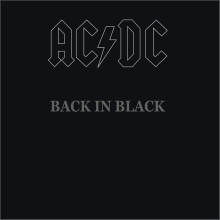
The album was composed by Johnson, Angus and Malcolm Young, and recorded over seven weeks in the Bahamas from April to May 1980 with producer Robert John "Mutt" Lange, who had worked on their previous album. Post-obit its completion, the group mixed Back in Black at Electrical Lady Studios in New York City. The album's all-black cover was designed as a "sign of mourning" for Scott.
As their sixth international studio release, Dorsum in Blackness was an unprecedented success. It has sold an estimated fifty million copies worldwide,[ane] [2] [three] [4] and is the second acknowledged album in music history. The band supported the album with a yearlong earth tour, cementing them amid the about popular music acts of the early 1980s. The anthology also received positive critical reception during its initial release, and it has since been included on numerous lists of "greatest" albums. Since its original release, the anthology has been reissued and remastered multiple times, most recently for digital distribution. On ix December 2019, information technology was certified 25x Platinum past the Recording Industry Association of America (RIAA).[5]
Background [edit]
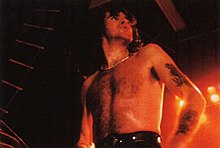
Bon Scott, the band's former vocalizer in December 1979.
AC/DC, formed in 1973, first broke into international markets in 1977 with their fourth album, Permit There Be Rock.[6] By 1979, they were poised for greater success with their sixth, Highway to Hell. Robert John "Mutt" Lange produced the record, making the band'south sound more catchy and accessible, and information technology became their outset gold anthology in the United States, selling over 500,000 copies, while also peaking at number 17 on that state's pop charts and number eight in the United Kingdom.[6]
As the new decade approached, the grouping gear up off for the United kingdom of great britain and northern ireland and French republic for the final bout dates of their quantum release.[seven] They planned to begin recording a follow-up shortly later on its completion. On nineteen February 1980, Scott went on a drinking binge in a London pub that acquired him to lose consciousness, then a friend let him rest in the back of his Renault 5 overnight. The side by side morning, Scott was found unresponsive and rushed to Male monarch's College Hospital where medical personnel pronounced him expressionless on arrival. The coroner ruled that pulmonary aspiration of vomit was the cause of Scott's death, only the official crusade was listed on the expiry certificate equally "acute alcoholic poisoning" and classified as "expiry by misadventure". Scott was cremated and his ashes were interred by his family at Fremantle Cemetery in Fremantle, Western Commonwealth of australia.[8] The loss devastated the band, who considered breaking upwardly. However, friends and family persuaded them to carry on.[9]
After Bon Scott's funeral, the ring immediately began auditions for a replacement frontman. At the communication of Lange, the group brought in Geordie vocalizer Brian Johnson, who impressed the group.[10] After the ring begrudgingly worked through the residue of the list of applicants in the following days, Johnson returned for a 2nd rehearsal.[xi] On 29 March, Malcolm Young chosen the singer to offering him the job, to his surprise.[12]
Recording and product [edit]

This is the beginning album to feature Brian Johnson (pictured in 1982) as atomic number 82 singer.
As the band commenced writing new fabric for the followup to Highway to Hell, vocalizer Bon Scott, who began his career as a drummer with The Spektors, recorded the drum tracks on demo recordings of "Let Me Put My Dear into You" and "Have a Drink on Me".[13]
In a 2022 interview with Paste, Angus Young confirmed that Scott's contributions to the album were limited to playing drums on early demo versions of the songs "Hells Bells" (instead of "Let Me Put My Love into You") and "Take a Drink on Me."[14]
Rehearsals for Dorsum in Black were scheduled over three weeks at London's E-Zee Hire Studios, just it was cutting to i week when an opening came up at Compass Point Studios in Nassau, in the Bahamas. Although they preferred to record their next try in the United kingdom, there were no studios available, and the Bahama islands presented a nice revenue enhancement advantage.[15]
Back in Black was recorded from mid-April to May 1980 at Compass Point with producer "Mutt" Lange. Upon their inflow, the area was being hit past several tropical storms, wreaking havoc on the studio's electricity. Johnson recalled that: "It was hardly any kind of studio, we were in these footling concrete cells, comfy listen, you had a bed and a chair. And this large old black lady ran the whole place. Oh, she was fearsome, she ruled that place with a rod of iron. We had to lock the doors at night considering she'd warned us about these Haitians who'd come down at night and rob the place. So she bought us all these six-pes fishing spears to proceed at the fucking door! It was a bit of a stretch from Newcastle, I can tell you."[16] In addition, their equipment was initially held upwards by customs, and other gear was slowly freighted over from the UK.[17] Johnson felt force per unit area during the process, having never recorded with the grouping. None of Scott's writings were used for the album'southward lyrics, as the group felt it would seemingly profit from his passing. Johnson reported having trouble adjusting to the environment, and fifty-fifty referenced the bad weather on the opening lines of "Hells Bells" ("I'm rolling thunder, pourin' rain. I'm comin' on like a hurricane. My lightning'due south flashing beyond the heaven. Y'all're only immature but you're gonna die.")[18] Lange focused item attention on Johnson's vocals, demanding perfection out of each take.[19]
It was like, 'Over again, Brian, over again – hold on, y'all sang that annotation besides long and so in that location'south no room for a breath'. He wouldn't let annihilation go past him. He had this thing where he didn't want people to listen to the anthology down the road and say there's no way someone could sing that, they've dropped that in, even the breaths had to be in the correct place. And you cannot knock a man for that, but he drove me nuts. I'd be sitting in that location going, 'Arrggghh!'.

The full general attitude in the studio was optimistic. Engineer Tony Platt was dismayed, notwithstanding, to find the studio'south rooms were not sonically complementary to the group'due south sound, which was designed to be very dry and compact.[20] A humorous anecdote from the sessions involved a recording beingness interrupted by a crab shuffling across the studio's wooden flooring.[21] Angus Young's detail guitar sound was accomplished in part by a wireless guitar device, the Schaffer–Vega diversity system, a Ken Schaffer design which provided a bespeak boost and was reissued every bit a dissever guitar issue in 2014.[22] [23]
Nearly the terminate of the process, the ring phoned manager Ian Jeffery in search of a bell to include on the album.[24] Jeffery located a foundry to produce the bell, but with seven weeks having already gone by, he suggested Platt tape a nearby church's bells. These recordings did non suffice due to the audio of a flurry of birds flying away at each bell hitting. The foundry brought forward production on the bell, which turned out perfectly tuned, and it was recorded with Ronnie Lane'due south Mobile Studio.[25] Following the recording's completion, the group mixed Back in Black at Electric Lady Studios in New York City.[26]
According to Angus Young, the album'due south all-black cover was a "sign of mourning" for Scott. Atlantic Records disagreed with the cover, but accepted if the band put a grey outline effectually the Air conditioning/DC logo.[eighteen]
Release and promotion [edit]
Back in Black was kickoff released in the United States on 25 July 1980. Its release in the United Kingdom and the residue of Europe followed on 31 July, and on 11 August in Australia.[27] It was an immediate commercial success, debuting at number ane on the British albums chart and reaching number 4 on the American nautical chart—which Rolling Stone called "an infrequent showing for a heavy-metal album".[28] It topped the British nautical chart for 2 weeks and remained in the summit x of the American chart for more five months. In Australia, it reached number two on the ARIA Charts.[27]
After Back in Blackness was released, Air conditioning/DC's previous records Highway to Hell, If Y'all Want Blood You lot've Got It, and Let There Be Rock all re-entered the British charts, which made them the first ring since The Beatles to have iv albums in the British Peak 100 simultaneously.[29] Back in Black 's American success prompted Atlantic, the band'south US record company, to release their 1976 Muddied Deeds Done Dirt Cheap album for the outset time in the US; in May 1981 information technology surpassed Dorsum in Black on the US nautical chart at number three.[27]
To promote the album, music videos were filmed for the songs "You Shook Me All Night Long", "Hells Bells", the championship track, "Stone and Roll Ain't Noise disturbance", "Let Me Put My Love into You", and "What Do You Practise for Money Honey". Only the first 4 were released as singles.[27] In the US, the single "You Shook Me All Dark Long"/"Have a Drink on Me" became AC/DC's first Top 40 hitting in the country, peaking at no. 35.[29]
On thirteen Dec 2007, the anthology was certified 22× multi-platinum by the RIAA, denoting 22 million American sales.[thirty] This placed it 6th in the list of all-time-selling albums in the The states.[31] Worldwide, it went on to sell fifty 1000000 copies, leading NME announcer Mark Beaumont to call it "the biggest selling hard stone anthology ever made";[32] rock historian Brock Helander said it was possibly "the acknowledged heavy-metal anthology in history".[33]
Disquisitional reception [edit]
| Review scores | |
|---|---|
| Source | Rating |
| AllMusic |  [34] [34] |
| Blender | [35] |
| Christgau's Record Guide | B− [36] |
| The Encyclopedia of Popular Music |  [37] [37] |
| The Great Stone Discography | 8/10[38] |
| MusicHound Rock | 5/5[39] |
| Pitchfork | 8.eight/x[40] |
| Rolling Stone | [41] |
| The Rolling Stone Anthology Guide | [42] |
| Spin Alternative Tape Guide | eight/x[38] |
Reviewing for Rolling Rock in 1980, David Fricke regarded Back in Blackness as "non just the all-time of AC/DC's six American albums" but "the noon of heavy-metal fine art: the first LP since Led Zeppelin 2 that captures all the blood, sweat and arrogance of the genre."[43] Red Starr from Boom Hits was more than disquisitional, finding the songs duplicate from 1 some other and marred by hypermasculine fantasies, stone music stock phrases, garish guitar, and slow rhythms, on "yet another triumph for lowest common denominator headbanging—the new thoroughly predictable, thoroughly dreadful AC/DC album." He gave the record a score of 3 out of ten.[44]
In a retrospective review, Rolling Stone critic Christian Hoard praised the album as the band'southward greatest work, perchance "the leanest and meanest record of all time—balls-out arena rock that punks could love."[41] Barry Walters from Rolling Stone said Back in Black "nevertheless sounds thoroughly timeless, the essence of unrepentantly simple but savagely crafted hard rock" and "a celebration of thrashing, animal sex activity", although he observed "hateful-spirited sexism" on songs such equally "What Practise You Do for Money Honey" and "Given the Dog a Bone".[45] Robert Christgau was less enthusiastic, finding the ring somewhat also "archaic" and their sexual imagery "unimaginative". "Angus Young does come up with killer riffs", he wrote in Christgau's Tape Guide: The '80s (1990), "though non as consistently equally a refined person like myself might hope, and lead singer Brian Johnson sings like in that location's a cattle prod at his scrotum, just the affair for fans who tin can't decide whether their newfound testosterone is desperation or ecstasy."[36]
As her favourite album, Kitty Empire of The Observer acknowledged Back in Blackness is "a preposterous, drongoid tape ... built on casual sexism, heart-rolling double entendres, a highly questionable attitude to sexual consent ('Don't you struggle/ Don't you lot fight/ Don't yous worry/ Cos information technology's your plough tonight') a penchant for firearms, and a crass celebration of the unthinking macho hedonism that killed the ring's original singer." Withal, she concurred with Fricke'due south original view of the anthology as a heavy metal masterpiece while naming it her favourite anthology ever, "the obsessive soundtrack of my adolescence, the racy middle-brow thriller that spoke to me both equally a tomboy who wanted to be ane of the guys, and the increasingly female ingenue who needed to piece of work out the world of men. Plus teenagers love death."[46]
The album is featured on many "best of" lists. In 1989, information technology was ranked No. 26 on Rolling Stone magazine'southward list of the 100 All-time Albums of the Eighties. The championship rails was ranked no. 190 on the same magazine's listing of the 500 Greatest Songs of All Time.[47] In 2001, VH1 ranked Back in Black No. 82 on its list of the Elevation 100 Albums.[48] VH1 also placed the title track at No. 2 on its list of the 100 Greatest Difficult Rock Songs. In 2003, the album was ranked No. 73 on Rolling Stone 's listing of "The 500 Greatest Albums of All Time",[49] No. 77 in a 2012 revised listing[50] and No. 84 in a 2022 revised list.[51] In 2006, Q placed the album at No. 9 in its list of the 40 Best Albums of the '80s.[52] That same year, Back in Black was included by Time in its list of the 100 Greatest Albums of All Time.[53] It was listed at No. 2 in the book, 100 All-time Australian Albums, in Oct 2010,[54] and included in the book 1001 Albums Y'all Must Hear Before You lot Die in 2005.[55]
Legacy and influence [edit]
Back in Black is an influential hard rock and heavy metal album.[56] According to Tim Jonze of The Guardian, it has been hailed by some as "a high watermark" for heavy metal music.[57] NME regarded it equally an important release in 1980s metallic and heavy stone, naming information technology one of the twenty best metal albums of its decade,[58] while The Daily Telegraph ranked it as ane of the 20 greatest heavy metal albums of all time.[59] Paul Brannigan of Metallic Hammer cited information technology as one of the 10 albums that helped reestablish the genre's global popularity in 1980, making it "the greatest yr for heavy metal".[60]
According to rock journalist Joe South. Harrington, Back in Black was released at a time when heavy metal stood at a turning point between a decline and a revival, as near bands in the genre were playing slower tempos and longer guitar solos, while Ac/DC and Van Halen adopted punk rock's "high-free energy implications" and "constricted their songs into more pop-oriented blasts". Harrington credited producer Lange for drawing AC/DC further away from the dejection-oriented rock of their previous albums, and toward a more than dynamic set on that concentrated and harmonized each chemical element of the band: "the guitars were compacted into a singular argument of rhythmic efficiency, the rhythm section provided the thunderhorse overdrive, and singer Johnson belowed and brayed similar the most unhinged practitioner of bluesy elevation-human dynamics since vintage Robert Plant." The resulting music, along with contemporaneous records past Motörhead and Ozzy Osbourne, helped revitalize and reintroduce metal to a younger generation of listeners, "eventually resulting in the punk-metallic crossover personified by Metallica and others."[61] In 1,000 Recordings to Hear Earlier You Die (2008), Tom Moon said Back in Black 's "lean hateful loonshit rock" and the production's "delicate residual of power and finesse" defined the commercial side of heavy music for years after its release."[62]
Lange's production for the anthology had an enduring bear on in the music industry; "to this twenty-four hours, producers still employ information technology as the de facto paint-by-numbers guidebook for how a difficult-rock tape should sound", Harrington wrote.[61] In the years later on its release, studios in Nashville would use it to check the acoustics of a room, while Motörhead would employ it to melody their sound system.[63] American death metallic group Six Feet Under recorded a cover of the unabridged album under the title Graveyard Classics two.[64]
In Dec 2021, the album was listed at number i in Rolling Stone Australia 's "200 Greatest Albums of All Time" countdown.[65]
Track listing [edit]
All tracks are written by Angus Young, Malcolm Immature and Brian Johnson.
| No. | Title | Length |
|---|---|---|
| one. | "Hells Bells" | five:ten |
| two. | "Shoot to Thrill" | 5:17 |
| 3. | "What Do Y'all Practise for Money Love" | three:33 |
| iv. | "Given the Dog a Bone" | 3:30 |
| 5. | "Allow Me Put My Love into Yous" | 4:16 |
| No. | Title | Length |
|---|---|---|
| half-dozen. | "Dorsum in Black" | 4:xv |
| 7. | "You Shook Me All Nighttime Long" | 3:thirty |
| eight. | "Take a Drink on Me" | 3:57 |
| 9. | "Shake a Leg" | 4:06 |
| 10. | "Stone and Roll Own't Racket Pollution" | 4:fifteen |
| Full length: | 42:11 | |
- According to the official AC/DC website and most worldwide releases, rail 4 is "Given the Canis familiaris a Bone".[66] [67] On some albums, item Australian releases, and also in the iTunes Store, it is sometimes shown as either "Givin' the Dog a Os" or "Giving the Domestic dog a Bone".[68] [69]
Personnel [edit]
AC/DC [edit]
- Brian Johnson – lead vocals
- Angus Young – lead guitar
- Malcolm Young – rhythm guitar, backing vocals
- Cliff Williams – bass guitar, backing vocals
- Phil Rudd – drums
Product [edit]
- Robert John "Mutt" Lange – production
- Tony Platt – assistant applied science
- Benji Armbrister – assistant engineering
- Jack Newber – assistant engineering
- Brad Samuelsohn – mixing
- Bob Ludwig – mastering (original LP)
- Barry Diament – mastering (original CD releases)
- Ted Jensen – remastering (EMI/Atco reissue)
- George Marino – remastering (Epic reissue)
- Bob Defrin – art direction
- Robert Ellis – photography
Charts [edit]
Weekly charts [edit]
| Year-end charts [edit]
|
Certifications [edit]
Run across also [edit]
- List of best-selling albums
- Listing of best-selling albums in Australia
- Listing of best-selling albums in France
- List of best-selling albums in the U.s.
- List of diamond-certified albums in Canada
- List of number-one albums in Australia during the 1980s
- Listing of Top 25 albums for 1980 in Australia
- List of Canadian number-ane albums of 1981
- List of UK Albums Chart number ones of the 1980s
References [edit]
- ^ Ma, Kai (6 June 2011). "Heavy Metallic Under the Bounding main: Sharks Act Calmer When Listening to Air conditioning/DC". Fourth dimension . Retrieved 5 June 2014.
- ^ Sutcliffe, Phil (2010). AC/DC: High-Voltage Stone 'n' Roll: The Ultimate Illustrated History. Voyageur Press.
- ^ McNamee, Gregory (24 August 2010). "AC/DC, "Dorsum in Black" (Corking Moments in Pop Music History)". Encyclopædia Britannica, Inc. Archived from the original on 21 Baronial 2014.
- ^ Mierendorf, Mike (2 August 2012). "Cultural Bear upon: AC/DC – 'Back in Black'". Cultural Transmogrifier Magazine. Archived from the original on 24 January 2013.
- ^ "Air-conditioning/DC'due south Back in Blackness Certified 25x Platinum". Kerrang!. 9 Dec 2019. Retrieved 30 Dec 2019.
- ^ a b "AC/DC – Artist Biography". AllMusic. Retrieved 10 February 2015.
- ^ Engleheart & Durieux 2008, p. 287.
- ^ Engleheart & Durieux 2008, p. 299.
- ^ Engleheart & Durieux 2008, p. 297.
- ^ Engleheart & Durieux 2008, p. 309.
- ^ Engleheart & Durieux 2008, p. 317–18.
- ^ Engleheart & Durieux 2008, p. 319–20.
- ^ Kielty, Martin (21 August 2020). "Angus Immature Even so Suffers from Phase Fright / 40 Facts About Air conditioning/DC'south 'Back in Black' / Bon Scott played drums on some of the demos". Ultimate Classic Rock . Retrieved 22 August 2020.
- ^ Wilkening, Matthew (22 February 2021). "Angus Young Shoots Downward Bon Scott 'Back in Black' Rumors". Ultimate Classic Rock . Retrieved 22 February 2021.
- ^ Engleheart & Durieux 2008, p. 324.
- ^ Wilding, Philip (25 July 2017). "AC/DC'southward Back In Black: the story behind the album". Classic Rock . Retrieved 19 December 2019.
- ^ Engleheart & Durieux 2008, p. 325.
- ^ a b "Back in Blackness 30th Anniversary". Fanclub.acdc.com. Archived from the original on 26 April 2015.
- ^ Engleheart & Durieux 2008, p. 329.
- ^ Engleheart & Durieux 2008, p. 327.
- ^ Engleheart & Durieux 2008, p. 330.
- ^ Molenda, Michael (June 2015). "The Schaffer Replica Pedal". Vintage Guitar. p. 124.
- ^ Molenda, Michael (May 2015). "Solving the Mystery of Angus Young's Classic Dorsum in Blackness Tone". Vintage Guitar. pp. l–51.
- ^ Engleheart & Durieux 2008, p. 331.
- ^ Engleheart & Durieux 2008, p. 332.
- ^ Dorsum in Black (liner notes). Ac/DC. US: Atlantic Records. 1980. SD 16018.
{{cite AV media notes}}: CS1 maint: others in cite AV media (notes) (link) - ^ a b c d Wilding, Philip (25 July 2017). "The Story Behind the Album: Air-conditioning/DC's Back in Black". Classic Rock . Retrieved 9 December 2018.
- ^ "26: AC/DC, 'Back in Black'". Rolling Stone. 16 November 1989. Retrieved 29 May 2012.
- ^ a b Engleheart, Murray; Durieux, Arnaud (2006). AC/DC: Maximum Rock & Whorl. HarperCollins. p. 339. ISBN0-7322-8383-3.
- ^ "RIAA – Gold & Platinum Searchable Database – Back in Black". Recording Industry Association of America. Retrieved 5 June 2014.
- ^ "RIAA – Tiptop 100 Albums". RIAA. Retrieved 29 May 2012.
- ^ Beaumont, Mark (24 July 2015). "10 Things Y'all Might Non Know About Air conditioning/DC'southward 'Back in Black'". NME . Retrieved 6 August 2018.
- ^ Helander, Brock (1996). The Rock Who's Who (2nd ed.). Schirmer Books. p. v. ISBN0028710312.
- ^ Erlewine, Stephen Thomas. "Air conditioning/DC – Back in Black". AllMusic . Retrieved 20 June 2012.
- ^ "AC/DC – Back in Black". Blender. Archived from the original on 9 April 2007.
- ^ a b Christgau, Robert (1990). "Ac/DC". Christgau'due south Record Guide: The '80s. Pantheon Books. p. 28. ISBN0-679-73015-10 . Retrieved 29 July 2018.
- ^ Larkin, Colin, ed. (2007). The Encyclopedia of Pop Music (5th Concise ed.). Uk: Jitney Press. p. 34. ISBN978-1-84609-856-7.
- ^ a b "Back in Black". Acclaimed Music. Retrieved 29 July 2018.
- ^ Graff, Gary; Durchholz, Daniel, eds. (1999). "Air-conditioning/DC". MusicHound Rock: The Essential Album Guide. Farmington Hills, MI: Visible Ink Printing. ISBNi-57859-061-2.
- ^ Kandell, Steve (16 June 2019). "AC/DC: Back in Blackness". Pitchfork . Retrieved 21 June 2019.
- ^ a b Hoard, Christian (10 Feb 2005). "AC/DC – Back In Black". Rolling Stone . Retrieved 20 June 2012.
- ^ Coleman, Marker; Ryan, Chris (2004). "Air conditioning/DC". In Brackett, Nathan; Hoard, Christian (eds.). The Rolling Stone Album Guide (4th ed.). Simon & Schuster. p. 4. ISBN0-7432-0169-8.
- ^ Fricke, David (27 November 1980). "AC/DC – Back In Black". Rolling Stone . Retrieved twenty June 2012.
- ^ Starr, Red. "Albums". Smash Hits. No. 21 August – 3 September 1980. p. 30. Retrieved 29 July 2018.
- ^ Walters, Barry (27 September 2002). "Air conditioning/DC – Back In Black". Rolling Rock . Retrieved twenty June 2012.
- ^ Empire, Kitty (5 August 2011). "My favourite anthology: Back in Black by Air conditioning/DC". The Observer . Retrieved six August 2018.
- ^ "500 Greatest Songs of All Time – 190: Ac/DC, 'Back in Black'". Rolling Stone . Retrieved 29 May 2012.
- ^ "The Top 100 Albums by VH1 (2001)". VH1. Retrieved 29 May 2012 – via All-time Ever Albums.
- ^ "500 Greatest Albums of All Time : 73 – Back in Blackness - Air conditioning/DC". Rolling Stone. Archived from the original on two June 2011.
- ^ "500 Greatest Albums of All Fourth dimension". Rolling Stone. 31 May 2012. Retrieved 23 September 2019.
- ^ "The 500 Greatest Albums of All Time". Rolling Stone. 22 September 2020. Retrieved nine October 2021.
- ^ Q. No. 241. Baronial 2006.
- ^ Tyrangiel, Josh (25 January 2010). "All-Time 100 Albums: Back in Blackness". Time . Retrieved 27 March 2020.
- ^ O'Donnell, John; Creswell, Toby; Mathieson, Craig (October 2010). 100 Best Australian Albums. Prahran, Vic: Hardie Grant Books. ISBN978-1-74066-955-ix.
- ^ "1001 Albums You Must Hear – 2008 Edition". Rocklist.internet . Retrieved 29 May 2012.
- ^ Clifford-Napoleone, Amber R. (2015). "Blackness Leather". Queerness in Heavy Metal Music: Metal Aptitude. Routledge Studies in Popular Music. Routledge. ISBN978-1317916543.
- ^ Jonze, Tim (14 April 2009). "A handy guide to heavy metal". The Guardian . Retrieved vii August 2018.
- ^ "The xx Best 80's Metal Albums". NME. 15 April 2018. Retrieved 7 August 2018.
- ^ "AC/DC: Back in Blackness – Top 20 Heavy Metal Albums". The Daily Telegraph. 25 September 2015. Archived from the original on 12 January 2022. Retrieved 6 August 2018.
- ^ Brannigan, Paul (4 February 2016). "Why 1980 was the greatest twelvemonth for heavy metal". Metal Hammer . Retrieved 7 August 2018.
- ^ a b Harrington, Joe S. (2003). "Back in Black". In Hoye, Jacob (ed.). VH-1'south 100 Greatest Albums. Simon & Schuster. pp. 81–82. ISBN0743448766.
- ^ Moon, Tom (2008). 1,000 Recordings to Hear Before You Die: A Listener's Life List. Workman Publishing. p. 5. ISBN978-0761139638.
- ^ Engleheart, Murray; Durieux, Arnaud (2006). Ac/DC: Maximum Rock & Roll. p. 337. ISBN0-7322-8383-iii.
- ^ Kergan, Wade. "Vi Anxiety Nether – Graveyard Classics, Vol. 2". AllMusic . Retrieved 28 November 2015.
- ^ "Rolling Rock's 200 Greatest Australian Albums of All Time". Rolling Rock Australia. half dozen Dec 2021. Retrieved 21 Feb 2022.
- ^ "Back in Black – Track Listings". Acdc.com. Archived from the original on 31 January 2013.
- ^ "U.s.a. CD version of Back in Black". Acdc-discography.com. Archived from the original on 4 March 2012. Retrieved 30 May 2012.
- ^ "Australian CD version of Back in Black". Acdc-discography.com. Archived from the original on 8 September 2011. Retrieved 3 September 2011.
- ^ "United states 2003 CD version of Back in Black". Amazon.com . Retrieved 17 September 2018.
- ^ "Austriancharts.at – Ac/DC – Back In Black" (in German). Hung Medien. Retrieved 5 June 2014.
- ^ a b "Les Albums (CD) de 1980 par InfoDisc". InfoDisc. Archived from the original on 9 January 2016.
- ^ "Offiziellecharts.de – Air-conditioning/DC – Back In Blackness" (in German). GfK Entertainment Charts. Retrieved v June 2014.
- ^ "Dutchcharts.nl – Air-conditioning/DC – Back In Black" (in Dutch). Hung Medien. Retrieved 5 June 2014.
- ^ "Swedishcharts.com – Ac/DC – Dorsum In Black". Hung Medien. Retrieved five June 2014.
- ^ "Official Albums Chart Top 100". Official Charts Company. Retrieved 5 June 2014.
- ^ "Back in Black – Awards". AllMusic. Archived from the original on 7 May 2016. Retrieved v June 2014.
- ^ Kent, David (1993). Australian Nautical chart Book 1970–1992. St Ives, N.S.W.: Australian Chart Book. ISBN0-646-11917-6.
- ^ "Pinnacle RPM Albums: Effect 0298". RPM. Library and Archives Canada. Retrieved 12 May 2015.
- ^ "Charts.nz – AC/DC – Back In Black". Hung Medien. Retrieved 5 June 2014.
- ^ "Norwegiancharts.com – AC/DC – Back In Black". Hung Medien. Retrieved 5 June 2014.
- ^ "Spanishcharts.com – Ac/DC – Dorsum In Black". Hung Medien. Retrieved 5 June 2014.
- ^ "Swisscharts.com – Air conditioning/DC – Back In Black". Hung Medien. Retrieved five June 2014.
- ^ "Danishcharts.dk – Air conditioning/DC – Dorsum In Black". Hung Medien. Retrieved five June 2014.
- ^ "AC/DC: Dorsum In Black" (in Finnish). Musiikkituottajat – IFPI Finland. Retrieved 5 June 2014.
- ^ "Australiancharts.com – Ac/DC – Dorsum In Blackness". Hung Medien. Retrieved v June 2014.
- ^ "Lescharts.com – AC/DC – Back In Black". Hung Medien. Retrieved 5 June 2014.
- ^ "AC DC Nautical chart History (Top Rock Albums)". Billboard. Retrieved 21 September 2021.
- ^ "Top 100 Album-Jahrescharts: 1980" (in German). GfK Entertainment. Retrieved 8 April 2021.
- ^ Kent, David (1993). Australian Chart Book 1970–1992 (illustrated ed.). St Ives, North.S.W.: Australian Chart Book. p. 433. ISBN0-646-11917-6.
- ^ "Tiptop 100 Albums of 1981". RPM. Vol. 35, no. 22. 26 Dec 1981. Retrieved 5 June 2014.
- ^ "Year-Finish Charts – Billboard 200 Albums: 1981". Billboard . Retrieved 8 April 2021.
- ^ "Year-Finish Charts: Billboard 200 Albums". Billboard . Retrieved 6 March 2020.
- ^ "Year-Finish Charts – Billboard 200 Albums: 2016". Billboard . Retrieved 8 April 2021.
- ^ "Year-Stop Charts – Top Rock Albums: 2017". Billboard . Retrieved viii April 2021.
- ^ "Twelvemonth-End Charts – Billboard 200 Albums: 2018". Billboard . Retrieved 8 April 2021.
- ^ "Year-End Charts – Top Rock Albums: 2018". Billboard . Retrieved viii April 2021.
- ^ "Yr-End Charts – Billboard 200 Albums: 2019". Billboard . Retrieved viii April 2021.
- ^ "Year-End Charts – Pinnacle Rock Albums: 2019". Billboard . Retrieved 8 April 2021.
- ^ "Årslista Album, 2020" (in Swedish). Sverigetopplistan. Retrieved 20 January 2021.
- ^ "Year-End Charts: Billboard 200 Albums". Billboard . Retrieved 7 December 2020.
- ^ "Year-End Charts – Top Rock Albums: 2020". Billboard . Retrieved viii April 2021.
- ^ "Årslista Album, 2021". Sverigetopplistan. Retrieved xiv January 2022.
- ^ "Year-End Charts: Billboard 200 Albums – 2021". Billboard . Retrieved 3 December 2021.
- ^ "Yr-Stop Charts: Pinnacle Rock Albums – 2021". Billboard . Retrieved 3 December 2021.
- ^ "Discos de Oro y Platino" (in Spanish). Cámara Argentine republic de Productores de Fonogramas y Videogramas. Archived from the original on 31 May 2011. Retrieved 7 December 2019.
- ^ Dale, David (10 January 2013). "The Tribal Mind Archive: The music Australia loved". The Sydney Forenoon Herald. Archived from the original on nineteen October 2015. Retrieved 28 November 2021.
- ^ "ARIA Charts – Accreditations – 2013 Albums" (PDF). Australian Recording Manufacture Association.
- ^ "Austrian album certifications – Air-conditioning/DC – Back in Black" (in German). IFPI Republic of austria.
- ^ "Canadian album certifications – AC/DC – Back in Blackness". Music Canada.
- ^ "Danish album certifications – Ac/DC – Back in Black". IFPI Danmark. Scroll through the page-list below until year 2022 to obtain certification.
- ^ "French album certifications – Air-conditioning/DC – Back in Blackness" (in French). Syndicat National de l'Édition Phonographique. Retrieved nine Nov 2021.
- ^ "Gilt-/Platin-Datenbank (AC/DC;'Dorsum in Black')" (in High german). Bundesverband Musikindustrie.
- ^ "Italian anthology certifications – AC/DC – Back in Black" (in Italian). Federazione Industria Musicale Italiana. Retrieved 1 March 2021. Select "2021" in the "Anno" drop-down menu. Select "Back in Black" in the "Filtra" field. Select "Album e Compilation" under "Sezione".
- ^ "New Zealand album certifications – AC/DC – Back in Black". Recorded Music NZ. Retrieved 11 Dec 2019.
- ^ "Wyróżnienia – Złote płyty CD - Archiwum - Przyznane west 2022 roku" (in Smoothen). Polish Order of the Phonographic Industry. Retrieved ix September 2021.
- ^ Salaverri, Fernando (September 2005). Sólo éxitos: año a año, 1959–2002 (1st ed.). Spain: Fundación Autor-SGAE. ISBN84-8048-639-2.
- ^ "The Official Swiss Charts and Music Community: Awards (Air-conditioning/DC;'Back in Blackness')". IFPI Switzerland. Hung Medien.
- ^ "British album certifications – Air conditioning/DC – Back in Blackness". British Phonographic Industry.
- ^ "American anthology certifications – Ac/DC – Back in Black". Recording Manufacture Association of America. Retrieved 7 December 2019.
Bibliography [edit]
- Engleheart, Murray; Durieux, Arnaud (2008). AC/DC: Maximum Stone & Coil . Harper Entertainment. ISBN978-0-06-113391-half-dozen.
External links [edit]
- Back in Blackness at Discogs (list of releases)
- Back in Black at MusicBrainz (list of releases)
Source: https://en.wikipedia.org/wiki/Back_in_Black
0 Response to "Men in Black Buy the White Album Again"
Post a Comment